
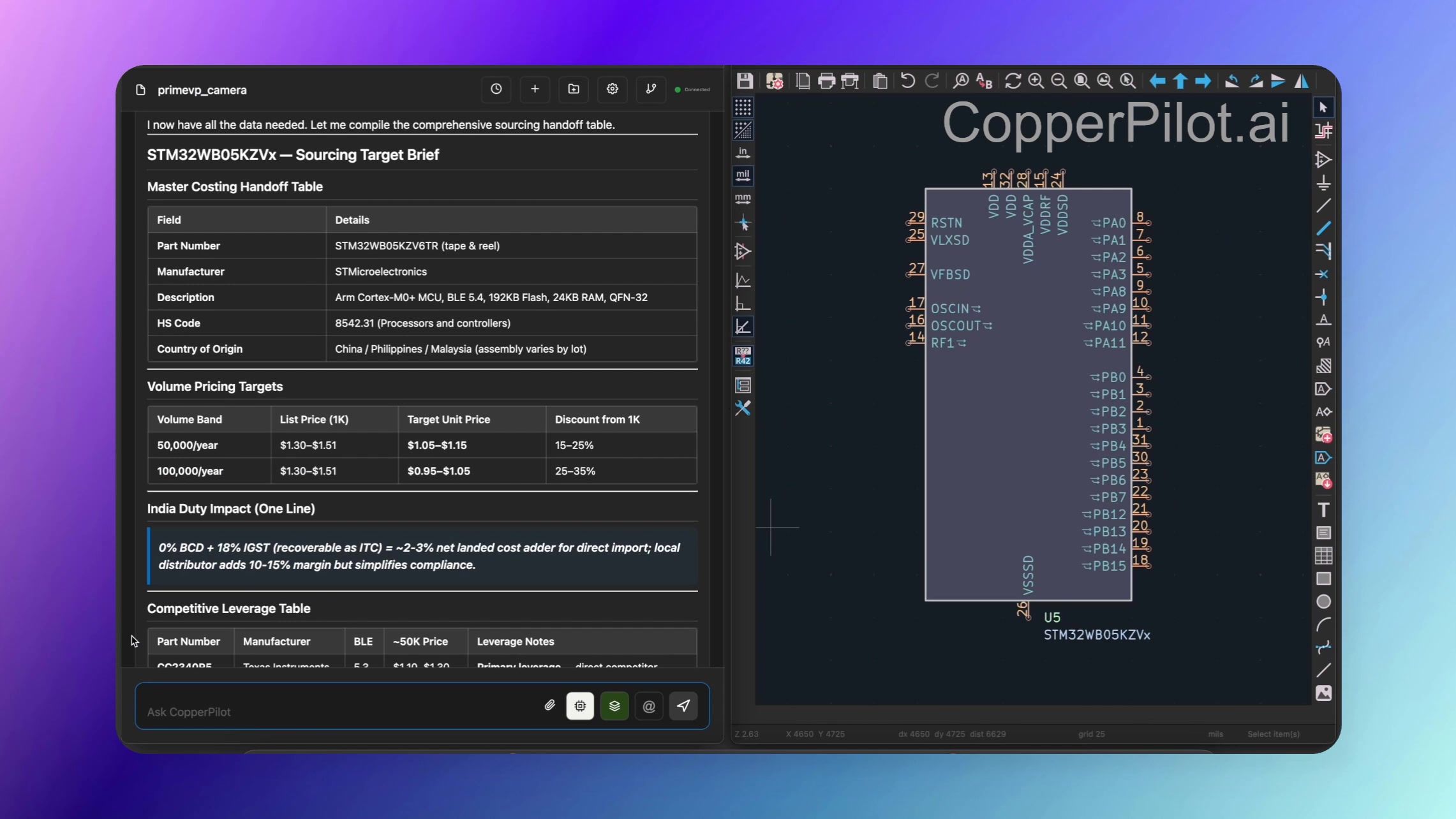
Design freezes, and then it’s up to costing to turn that into a target number. That
target gets handed off to sourcing so they have something concrete to work with. The
challenging part isn’t just setting the target—it’s crafting the brief. You need to
consider HS codes, identify who can actually supply the part, assess single-source risks,
determine what you should be paying at volume, and calculate duties and landed costs. That
usually means jumping between tariff sites, distributor pages, and spreadsheets, with the
best market or trade context scattered across the internet.
What This Demo Does
CopperPilot does this sourcing research right alongside the part in your schematic. This
demo addresses four questions about one part and culminates with a single brief you can hand
off to sourcing. The demonstration focuses on the STM32.
Question 1: Classification and Supply
First, explore what the open web can provide about the part: its classification, potential
suppliers, and inherent risks. This involves examining the HS code, distributors by region,
and identifying risks. In one concise chart you get the classification, a clear view of
authorized suppliers by region, and an honest risk assessment.
If there’s only one manufacturer, the tool will say so—but it also shows that
distribution may be extensive and the product actively promoted. The key takeaway is that
you’re not cornered, but you should be aware of alternatives in case you need to
leverage them. CopperPilot identifies those options for you; no need to hunt for
information—it’s already structured for handoff.
Question 2: Volume Targets and Competition
Next, consider insights you’d typically gain from experience or numerous phone calls:
What should your aim be at 50,000 and 100,000 units? Who are your competitors in this
space? You receive a volume guide along with a brief competitive landscape—who else is
operating in the same range and what are their approximate prices at 50,000 units?
The pricing band it outlines is especially helpful. At 50,000 units you can strategically
push; at 100,000 units you can feasibly aim for a price under one dollar with a
commitment. It identifies the key competitor as your leverage point in negotiations, the
one that’s crucial for winning designs. When you meet with SP or a distributor,
you’re well-prepared with a target and a compelling narrative.
Question 3: Origin and India Border
Where does this part originate, and what does India do at the border? Then there’s a
crucial decision: direct import versus purchasing from a local distributor. You receive
standard origin and assembly site information (not just headquarters), along with
India’s duty overview—for example, zero basic duty for this category, with most costs
being reimbursable IGST.
The summary is clear: direct import is cheaper per unit but involves paperwork and impacts
working capital; buying from a local distributor is straightforward but incurs additional
margins. The tool outlines when the savings justify direct import and when they don’t,
so you can make informed decisions with the right trade-offs.
Question 4: The Brief
Take all the information gathered and compile it into one concise brief—a document you’d
actually hand over to sourcing. It incorporates any available EXIM context so the brief is
well-grounded. You get a table and a succinct summary that includes the part, HS code,
volume, target prices for 50,000 and 100,000 units, a brief note on India duty, and a
clear target for the sourcing line, plus the leverage point you’d use in negotiations.
By the end you have a document ready to send: “Here’s the part, here’s the
target, here’s what to ask for.” No further assembly required.
Key Takeaways
- Four questions, one part, one brief—you don’t need to leave the design tool or open multiple browser tabs.
- You get classification, supply structure, risk assessment, volume target, and negotiation strategy in one place.
- Insights on duty and landed-cost trade-offs are wrapped into a single handoff for sourcing.
If you want to test this on your own Bill of Materials, we’re in early access at
copperpilot.ai.